Students Are Talking About Transparency. We Should be Listening.
- Alana Sobelman
- Jul 18, 2025
- 3 min read

Over the last month, TrustED conducted an online survey of more than 200 admitted and currently enrolled international students at U.S. universities. The survey explored how students perceive the clarity, transparency, and accuracy of key information provided by their institutions, with a focus on categories like cost, career outcomes, reputation, course content, and support services.
So what kinds of transparency do students value most?
Here’s what students said when asked about the most important factor influencing their university choice:

We see that nearly 70% of students base their decisions primarily on career outcomes and university reputation.
Interestingly, findings from a 2024 GradRight survey of nearly1,000 US-bound international students reveals that admits overwhelmingly cite cost as the primary reason they declined enrollment at what were initially their top choice universities.

This tells us that, while students may be hopeful about the affordability of their top-choice institutions, it is precisely lack of affordability that prevents their enrollment. Yet another reason why institutions should ease students’ selection journey by being upfront about tuition and costs.
How Transparent Do Students Find Their Institutions?
Our recent survey initially asked students to name the top three most important pieces of information for choosing their institution. Respondents were asked to share how accessible (for admits) and accurate (for enrolled students) the information about their institution is based on a 4-point scale.
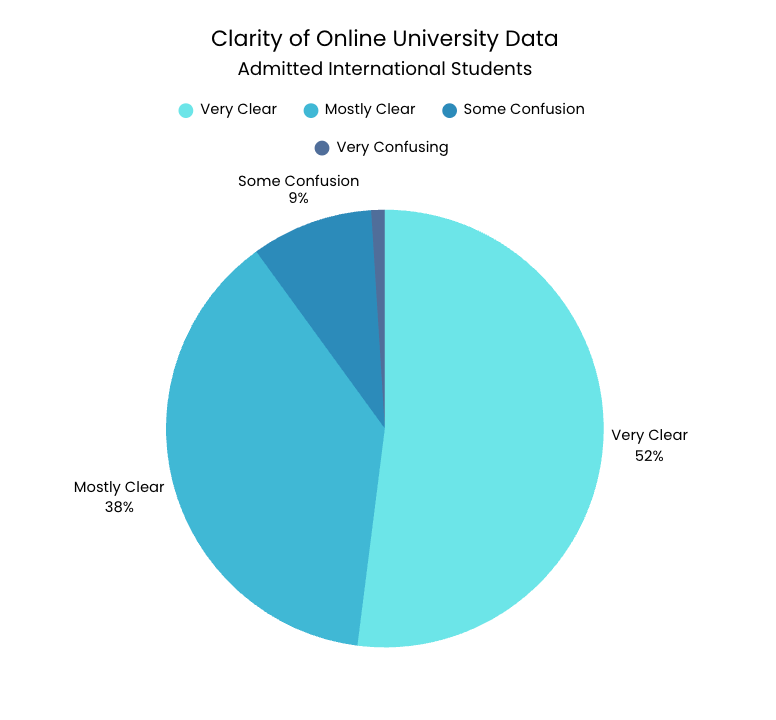
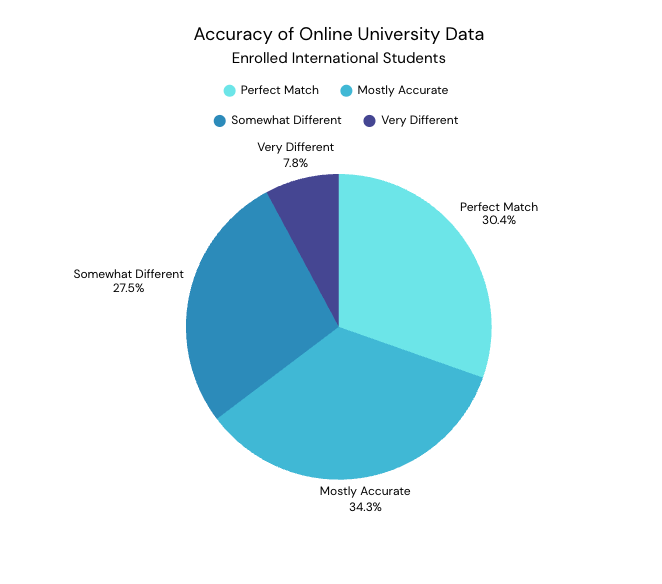
Comparing the two sets of results, there is a notable drop in perceived transparency from pre-enrollment (where 90%+ of students said information was clear or mostly clear) to post-enrollment (where only 31% said their experience perfectly matched expectations). This “clarity gap” highlights the difference between institutional promises and actual student experience.
Where Is Transparency Strongest—and Weakest?
The Pretty Good News:
University reputation, course content, and published costs are reported as clearest information categories.
Over 80% of admitted students rated their top factor as either “very clear” or “mostly clear.”
The Gaps:
Only 31% of enrolled students say that the communication about their top decision factor perfectly matched reality.
About 1 in 3 students found their experience diverged from institutional promises, particularly regarding cost, outcomes, and job-related support.
Recent surveys from other higher education authorities confirm the demand for transparency.
A 2023 survey by Third Way and Global Strategy Group of 1,000+ graduate students in the U.S. found that over 90% “strongly support” or “somewhat support” increased transparency around graduation rates, employment rates, typical income of graduates, and debt-to-earnings ratios, regardless of political ideology. The survey concluded that the “overarching sentiment was clear: students want more transparency from their graduate schools and for schools to be held accountable for poor outcomes”.1
The 2024 Student Academic Experience Survey (UK) from the Higher Education Policy Institute reported that only 53% of students felt “well-informed” about costs, and less than 40% trusted the accuracy of completion data. These findings echo the TrustED results—students appreciate clarity but often find institutional information lacking in depth or reliability.2
These surveys reinforce TrustED’s findings: students require real access to accurate information. They look for direct, actionable answers on costs, outcomes, and ROI. Institutions must truly recognize the critical importance of earning and keeping students’ trust; their actionable prioritization of this trust will shift the way they strategize their communications and drive enrollments, especially in times of instability.
Stay tuned for the full report on student perspectives on higher education transparency, reflecting engagements with thousands of students, set to come out in September, 2025.


Comments